
Dallas-Fort Worth Airport Terminals
The airport consists of five semicircular opposing terminals (A, B, C, D, E), with the International Parkway and other roadway systems in between. Inside each terminal semicircle is a parking garage. Terminals C and D also feature on-site hotels.
DFW Terminals Frequently Asked Questions
What is the fastest way to change terminals at DFW?
Without a doubt, the Skylink. It is a free automated train that operates inside the security zone (airside). It runs every 2 minutes and connects all five terminals. If you use the "Terminal Link" bus (landside), you will have to go through security again, which will cost you a lot of time.
Which terminal should I avoid for pick-ups?
Currently, Terminal C presents the greatest challenges due to massive construction projects. Users describe it as chaotic for vehicle pick-ups (Uber/Lyft/Family), with complicated access and congested waiting areas. If possible, move to another terminal to exit.
Which is the best terminal for a long layover?
Terminal D is, by consensus, the highest-rated. It is the international terminal—modern, with the best dining options, shops, and the most prominent VIP lounges (such as the Capital One Lounge and the Flagship Lounge).
From which terminal does the DART train to Dallas depart?
The DART train (Orange Line) departs exclusively from Terminal A, on the Lower Level. If you land at another terminal, use the Skylink to get to Terminal A before leaving the secure area.
Image
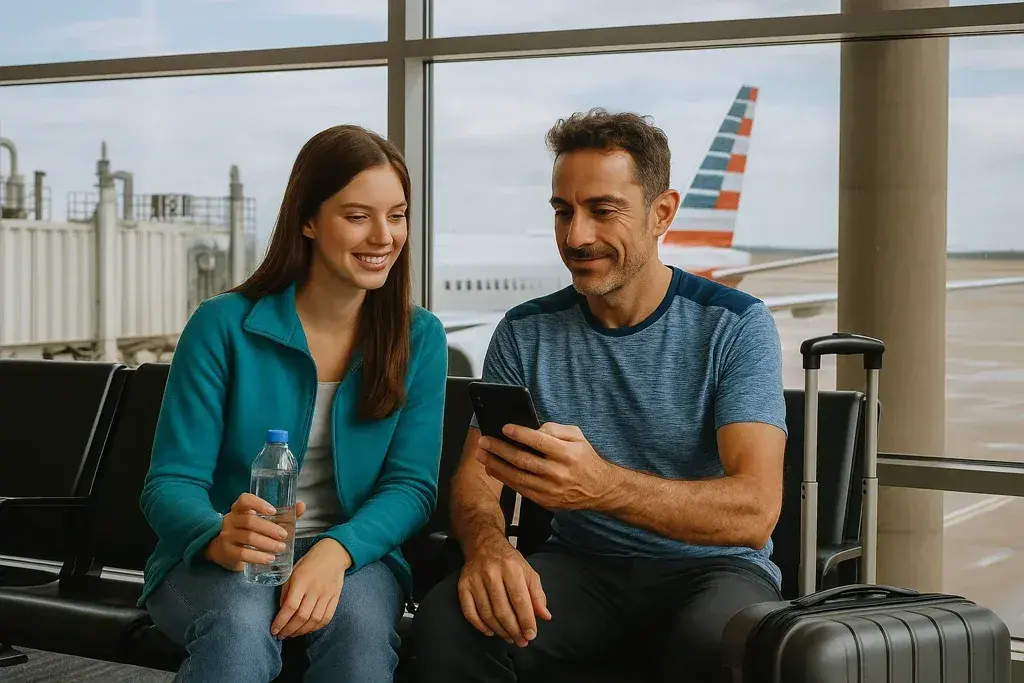
Image generated with AI
Traveler’s Manual: Critical Points at DFW
After analyzing hundreds of recent experiences, we have detected patterns that can save your trip. DFW is efficient, but its size and current renovations require strategy.
The Gate Shuffle
A constant complaint is the sudden change of boarding gates, often moving you from one terminal to another (e.g., from A to C) with little notice. Airport screens sometimes lag behind operational reality.
Strategy:
Do not blindly trust the gate printed on your boarding pass. Download the American Airlines app (or your airline's app) and verify the gate as soon as you land and again 40 minutes before boarding. Stay near a Skylink station until your gate is confirmed.
Thermal Inconsistency
Reports regarding temperature are extreme and contradictory: "freezing" zones due to air conditioning (especially on the Skylink and in yoga rooms) versus sweltering, hot zones in jet bridges or older terminals like Terminal C.
Strategy:
Dress in layers. Always keep a sweatshirt or light jacket accessible in your carry-on luggage, regardless of the season in Texas.
Duty Free Purchases and Connections
If you arrive on an international flight and have a domestic connection, be careful with liquids (alcohol, perfumes) purchased at the Duty Free of your origin. Even if they are sealed, if you must collect your luggage and go through security again, TSA might confiscate them.
Strategy:
If you have to re-check luggage after customs, place your liquid purchases in your checked bag before dropping it off at the connection counter. Do not try to take them through the carry-on security checkpoint.
User impressions of the airport are varied. While some highlight the convenience of the inter-terminal transport services and the wide range of shops and restaurants, others mention difficulties related to signage, facility maintenance, and connection management. The opinions reflected here come from multiple reviews on Google, Yelp, and other frequent traveler sources.
Below are details of the terminals along with traveler experiences, highlighting positive and negative aspects of each terminal.
Connecting Between Terminals
Pre-Security
All terminals are connected outside the secure area by the free Terminal Link bus service, which stops at all terminals from 5:00 am to 12:00 am. Outside those hours, it is only available by calling Tel +1 972 574 5465. Buses operate every 10 minutes from the upper level of each terminal, except at Terminal D, where pick-up and drop-off take place on the lower level. All vehicles are wheelchair accessible.
Passengers comment that the free Terminal Link bus service is a useful way to move between terminals before passing through security. However, some mention that buses can be crowded and waiting times can be long, which causes concern especially for tight connections.
Terminal Link shuttle buses operate from:
- Terminal A
- Gate A10 to gates A1-A20 and the airport's DART train station
- Gate A29 to gates A21-A39
- Terminal B
- Gate B17 to gates B1-B25
- Gate B46 to gates B26-B49 and the airport's TEXRail station
- Terminal C
- Gate C8 to gates C1-C39
- Terminal D
- Gate D17 to gates D1-D22
- Gate D28 to gates D23-D40
- Terminal E
- Gate E10 to gates E2-E18
- Gate E35 to gates E20-E38
Post-Security
The free Skylink light rail allows passengers to connect between terminals while remaining within the secure area (if your flight arrival allows it, depending on immigration and customs requirements).
The train operates 24 hours a day and departs every 2 minutes from two stations within each terminal. With trains running clockwise and counter-clockwise, the maximum travel time between the farthest points is only 9 minutes.
The Skylink train is praised for its efficiency and speed in moving within the secure area. However, at certain times, passengers experience delays or technical issues that lengthen transfer times between terminals. Even so, many consider this system a major advantage of the airport.
On the other hand, ground transportation is accessible from the internal landside areas (pre-security) of each terminal.
Terminal A
Terminal A has 3 levels:
Level 1 (lower), Level 2 (boarding and check-in), Level 3 (Skylink stop, gates A8/A20 and A21/A39)
This terminal has 36 gates and is used exclusively by American Airlines. It is connected to Terminals B and C via walkways in the secure area.
To reach Terminal B on foot, take the escalators or the elevator in front of gate 39 to the Skylink walkway. To reach Terminal C, the walkway is located just past gate 39, on the same level as the departures. Both paths feature moving walkways.
Positive aspects: Many passengers appreciate the smooth connection from this terminal to terminals B and C via walkways. The varied range of shops and restaurants is also highlighted, making the wait more pleasant.
Negative aspects: Some travelers mention that seating areas can be insufficient during peak hours, and some comments suggest that the terminal can become congested during high-traffic times.
User Experience: This terminal is the nerve center for those looking to connect to the city center, as the DART station (Orange Line) is located here. However, be careful: the entrance is on the Lower Level (Entrance A10), not the upper level, which confuses many travelers. Additionally, if you are looking to rest, there are seats with footrests near gate A18.
Terminal B
Terminal B has 3 levels:
Level 1 (lower), Level 2 (boarding and check-in), Level 3 (Skylink station, gates B1/B25 and B26/B49)
Composed of 45 gates, it also exclusively serves American Airlines flights for domestic routes only. Terminal B is connected to Terminals A and D via walkways in the airside zone.
To reach Terminal A, continue past gate B4 and take the elevator or go up to the Skylink platform, where there are moving walkways.
To connect to Terminal D, pass gate B1 and turn right. There are no moving walkways on this path.
Positive aspects: Frequent travelers appreciate the relative quiet of this terminal compared to other busier ones and highlight that security lines are usually fast and efficient.
Negative aspects: Critics point to problems with signage and a lack of clear assistance, which can cause confusion when moving between terminals or toward ground transportation.
User Experience: Perception is mixed. While some areas feel renovated ("modern and spacious"), other areas, especially the women's restrooms, receive complaints for being old and narrow. A highlight is the USO Center, considered one of the best for military personnel and families, offering a quiet refuge inside security. On the other hand, the Admirals Club in this terminal has a reputation for being small and neglected, so you might want to look for other options if you have time.
Terminal C
Terminal C has 4 levels:
Level 1 (lower), Level 2 (boarding and check-in), Level 3 (mezzanine), Level 4 (Skylink stop, gates C1/C20 and C21/C39)
This terminal is composed of 38 gates and, like the previous two, is also used exclusively by American Airlines. It connects to Terminal A via a walkway in the secure area that can be accessed past gate C2, on the departures level.
For connections to Terminal D, take the elevator or escalator just past gate C2 to Level 3, toward the Skylink platform, where moving walkways will take you to your destination.
Positive aspects: Terminal C offers a good connection to Terminal A and has easy access to the Skylink, which speeds up flight connections. Many passengers find the layout of shops and restaurants convenient.
Negative aspects: Several users mention that the terminal facilities need renovation, especially in areas like restrooms and rest spaces, which are perceived as old or poorly maintained.
User Experience: Use caution here. Currently, Terminal C is frequently described as a "war zone" due to heavy renovations. This critically affects logistics: finding your ride (rideshare/taxi) can be an odyssey of dark and poorly marked paths. If you are staying overnight, look for gate C18, where comfortable seats for resting are reported.
Terminal D
Terminal D has 4 levels:
Level 1 (baggage claim), Level 3 (boarding and check-in), Level 4 (mezzanine), Level 5 (Skylink station, gates D1/D22 and D23/D40)
It has 33 gates and is the main international terminal at DFW, with a variety of airlines operating various routes. It also handles some domestic arrivals and departures.
Passing gate D40 and turning the corner on the same level, you can reach Terminal B, and by taking the escalator or elevator to the Skylink connector bridge, you reach Terminal C.
Positive aspects: Many international travelers appreciate the variety of shops and food options found in this terminal. Users also highlight the efficiency of the Skylink for quick connections.
Negative aspects: Some passengers complain about confusion caused by last-minute gate changes, which increases connection stress. Additionally, organizational issues in customs and security areas are reported during peak hours.
User Experience: It is widely considered the jewel of DFW. Here you will find the best options for dining and relaxing, including the highly praised Capital One Lounge and the AA Flagship Lounge. If you have a long layover, this is the place to be. It even features yoga zones and showers (although the yoga zone can be extremely cold, so bring a jacket).
Terminal E
It has 3 levels:
Level 1 (lower), Level 2 (boarding and check-in), Level 3 (Skylink stop, gates E2/E18 and E20/E38)
It has 41 gates serving flights across the United States and Canada. As the only terminal not directly connected to another via walkways, all connections to and from Terminal E must be made via the Skylink to maintain airside access or by using the Terminal Link ground bus service and passing through security again at the connecting terminal.
Positive aspects: Passengers highlight that Terminal E is one of the least crowded, allowing for faster security processing and fewer crowds. Additionally, many value the relative tranquility of this terminal compared to others, especially for domestic flights.
Negative aspects: Some users have reported difficulties connecting to other terminals since Terminal E is not directly connected via walkways. This forces reliance on the Skylink or Terminal Link, which can be confusing and cause stress on tight connections.
User Experience: Being the base for low-cost carriers (Spirit, Frontier) and other domestic airlines, the service offering is limited. Some travelers describe it as "solitary confinement" due to the lack of healthy food options and entertainment (books/magazines).
Strategy:
If you are departing from here, bring your own supplies (food, reading material) and a full water bottle, as you might not find what you need once inside. However, the Plaza Premium Lounge in this terminal receives praise for its friendly staff if you have access to it.